Considering MJB Growth? Read This First.
MJB Growth Review: A Documented Client Experience
I'm writing this because when I was evaluating MJB Growth, I looked for reviews and found nothing. No TrustPilot, no third-party reviews, no client testimonials I could independently verify. I want the next person searching for “MJB Growth review” to have more information than I did.
I'm Cody, an online photography educator. I hired MJB Growth — Max Bates' done-for-you fractional operations and sales agency — to help me relaunch a product I had already launched successfully on my own. I'd done the sales calls, the operations, the applications, the entire backend — by myself. It worked. But it was a lot of work, so I wanted help scaling it.
MJB Growth promised to build backend systems, handle the sales process by hiring and managing setters and closers, and provide a dedicated sales manager. I signed on for a $15,000 package based on those promises. The result: zero closes, zero revenue, a damaged reputation, and a launch that collapsed on day one.
The Numbers Speak for Themselves
I had run a successful launch on my own before hiring MJB Growth. Here's what happened when they took over versus what I achieved solo.
Timeline of Events
What follows is a factual, chronological account of my experience with MJB Growth from onboarding through termination. Every event described is documented with Slack messages, Loom recordings, emails, or CRM data.
From the moment I signed on, I had no clear idea what was being built or why specific changes were being made to my business. There was no onboarding audit, no plan walkthrough, no Loom video laying out the strategy — nothing that said "here's what we're doing, here's why, and here's when we'll check in next." I was paying $15,000 for a done-for-you service and I was completely in the dark about what was actually being done.
Messages went unanswered for days at a time. I'd send a message and get no response for days. When I asked to get on a phone call to discuss strategy or tactics, the team was consistently unwilling. I got on exactly one call each with the operations lead and the head of sales, respectively. Neither was willing to get on a second call.
Max Bates himself repeatedly brushed me off when I attempted to get on a call so that I could get a glimpse into what was being built on my behalf. I was repeatedly told, “We've done this many times. Just trust us and let us do our work.” He hadn't spoken to me since the initial sales call where I'd agreed to the $15,000 package. It wasn't until the next major mistake — when his VA deleted my landing page — that he finally agreed to get on the phone.
On top of the communication issues, I discovered a security concern: MJB's VAs had access to my passwords via a shared Google Sheet. I was explicitly told during onboarding that all VAs worked exclusively through LastPass. That was not true — they had access to the raw password spreadsheet from the start.
One of MJB's VAs deleted the landing page I had spent weeks building. Not accidentally overwritten — the VA took my existing landing page and turned it into the privacy policy page, instead of simply creating a new page for the privacy policy. Weeks of carefully crafted copy, curated social proof, testimonial placement, and design work were wiped out entirely.
There was no backup. No version control. No “hey, I'm about to make a major change to your landing page” message. I found out after the fact and had to rebuild the entire page from scratch. This was the single most important asset of the entire launch, and it had been deleted.
To his credit, Max Bates did reach out and genuinely apologized. He said what happened was unacceptable and promised they would make it right. But the actions that followed did not match the words. There was no extra support in helping me rebuild the landing page. The rebuild support that was actually provided looked like something made by a preschooler — it was so bad, so ugly, that it didn't come close to representing the polish you'd expect from a high-ticket offer.
I had seen some of the previous landing pages MJB had shown me as examples of their work. When I pushed back and said I wanted my rebuilt page to at least look as good as it had been before — or at minimum on par with those examples — I was essentially told I was being too picky. Even though I wasn't the one who deleted the landing page in the first place.
After the landing page deletion, MJB promised strong support to make it right and get the page rebuilt quickly. What followed was a week of me doing the vast majority of the work myself — reconstructing copy, reorganizing social proof, providing detailed feedback documents — while MJB's VA claimed to be implementing my changes.
At one point, the VA told the team channel: "All feedback and assets have been applied to the landing page already." I reviewed the page and found this was categorically untrue:
- Sections weren't segmented properly — everything was crammed together
- The copy on the page didn't match the Google Doc I'd provided with clear, line-by-line instructions
- Design elements and feedback were ignored entirely
- Spacing and padding were inadequate and cramped throughout
When I dug into the ClickFunnels editor to understand why everything looked so cramped, I discovered the VA was using empty rows and blank boxes as spacers instead of the platform's built-in section padding controls. This is ClickFunnels 101 — the most fundamental aspect of page building. It confirmed that the VA didn't actually know how to use the tool they were supposed to be experts in.
When I pointed this out to Max Bates, he gaslit me — telling me that this was actually how ClickFunnels works and that the blank-box method was correct. It wasn't. When you loaded the page on mobile and desktop, it looked wonky and unprofessional. The platform has built-in padding controls for a reason.
I recorded a detailed Loom walkthrough documenting every issue and sent it to the team. The pattern was becoming clear: every time their team touched my page, the quality went down. Every time I touched it, it got better. I was paying $15,000 to do the work myself and clean up after their mistakes.
Throughout this entire process, Max made me feel like I was being a difficult customer — when in reality, I was just trying to get a reasonable amount of support for the $15,000 I had paid.
The week before launch should have been final checks and confidence-building. Instead, it was a cascade of broken commitments:
- Weekly Loom updates: The operations lead promised to send me a Loom video every Friday with progress updates. Over the entire engagement, maybe two were ever sent.
- Wednesday landing page draft: I was told the rebuilt landing page would be ready for review on Wednesday. The deadline passed with no delivery and no communication about the miss.
- Thursday demo call: A demo call was proposed for Thursday at 10 AM PST so I could see the full system before launch. No calendar invite ever arrived. No confirmation. It just didn't happen.
- Sales rep onboarding: Rep onboarding was supposed to start Monday. By mid-week, I had zero visibility on whether anyone had even been recruited, let alone trained. When I asked, I got vague reassurances instead of specifics.
- Contracts and legal: MJB told me I needed to set up contracts for students. When I logged into the system, it literally asked me to "set up my first document." They hadn't even started this. Another promise, another ball dropped.
Three days from launch, there was no confirmed sales infrastructure. No setters confirmed and trained. No closer I'd seen in action. No demo of the systems I'd been told were being built. I sent a firm message to Max Bates, the operations lead, and the head of sales outlining every gap.
Max's response was textbook passive-aggressive deflection. Rather than acknowledging the failures and committing to fix them, he essentially communicated a soft version of "fine, do it yourself then." When a client documents systemic execution failures and the agency owner's response is defensiveness rather than accountability, that tells you everything you need to know about the culture of the organization.
The email CTA went live. 446 people clicked through. Applications started flowing in. For the first time in weeks, there was real momentum. Every single person booking a sales call had already filled out an application explicitly stating they were ready to invest thousands of dollars in the program. These weren't cold leads — they were warm, qualified prospects who had raised their hand and said they wanted in. And then the sales infrastructure that was promised to be “ready” completely collapsed.
The Closer No-Showed
Multiple prospects who had booked sales calls were met with an empty meeting room. One prospect — someone who was genuinely interested and ready to invest thousands of dollars in my program — showed up to their scheduled call, waited 10 minutes, and left. They emailed me directly, frustrated: "I dropped off after waiting 10 minutes. Reach out if there's another time to meet about the cohort."
Another prospect also reported the closer didn't show up. When they tried to reschedule, the calendar system only offered 2:00 AM as an available time slot. They emailed asking if more times would be added. These are people who wanted to buy, and MJB's infrastructure actively pushed them away.
I Found Out From My Own Customers
The most damning part: I found out about these no-shows from angry prospect emails — not from the MJB team. There was zero proactive communication. No one on the team flagged that the closer wasn't showing up. No one noticed. No one told me. I had to discover from my own prospects that the sales team I was paying for had completely failed to appear.
The Closer Was Unreachable
When I tried to reach the closer through Slack, he wouldn't acknowledge any of my messages. He was completely unresponsive. I couldn't see his call recordings. I couldn't tell if he'd completed any of the training materials. There was no end-of-call form being filled out, so nothing was updating in the CRM. He was a ghost who was supposed to be closing deals worth thousands of dollars on my behalf.
The Setters Didn't Know the Offer
When I pulled up the setter calls to understand what was happening on the front end, I discovered the setters didn't actually know what they were selling. They couldn't articulate the offer. They were fumbling through conversations with real prospects who had expressed real interest.
When I asked the head of sales what training the setters had received, his answer was revealing: "They have all the offer docs and we told them to review them." I asked if he'd tested them for comprehension — had they actually internalized the offer? Could they speak to it naturally? His response: "Well, no, I'm not sitting there drilling them and testing them."
That's literally the job of a head of sales: to train the reps, test their knowledge, role-play objections, and ensure they're ready before putting them in front of real prospects. Instead, they were handed documents and sent to represent my brand with zero verification that they could do so competently.
The CRM Was a Fiction
MJB had built out CRM systems, tracking pipelines, and end-of-call forms — none of which were actually being used. The closer wasn't filling out end-of-call forms, so deal stages weren't updating. A setter confirmed they'd spoken to a prospect in Poland and agreed on a follow-up time, but when I checked the CRM, there was no booking. No Calendly link. Nothing. The CRM that was supposed to give me visibility into the sales process was essentially empty. All those systems they'd built — what was the point if nobody used them?
While MJB's team was silent, I went into damage control mode. I personally emailed apologies to every prospect who'd been no-showed. I offered my own calendar link. I took over the sales calls myself. I sent urgent messages to the operations channel demanding answers about what had happened and why no one had flagged it.
The head of sales eventually got on one of the afternoon calls when the closer was still missing. But even then, I was the one who had to escalate, chase, and coordinate. The agency I was paying $15,000 to run my sales operations was nowhere to be found during the most critical 48 hours of the entire engagement.
After three days of live launch producing zero closes, multiple no-shows, an unreachable closer, untrained setters, an unused CRM, and zero proactive communication from anyone on the MJB team, I made the decision to terminate the engagement.
I revoked MJB's access to my business systems, took back full control of the sales process, and redirected all prospect communication to myself. The final numbers told the story: 1,690 email clicks, 113 applications, 21 booked opportunities, 0 closes, $0 revenue.
For context: when I ran this same launch myself, I converted 48% of applications into booked calls, 80% showed up, and I closed 30%. If I had simply done nothing differently from my previous launch and handled those same 113 applications myself, I would have closed approximately 13 sales worth thousands of dollars each. Instead, MJB's "done-for-you" team produced zero.
What a Real Prospect Said
I'm not the only one who noticed the quality problem. After the launch collapsed, I received an unsolicited email from a prospect who had managed to get on a call with MJB's closer before the no-shows began. This person was actively interested in purchasing — they had clicked through, applied, and booked a call. Here's what they wrote:
"I was disappointed in the quality of the interaction and I left the call far less interested in signing on for the course than I was in the beginning. The interaction felt like he was given a high school assignment of interviewing me for a class. And like a high-schooler, he seemed like a slightly disinterested teenager and was just reading what he was told to ask me. After watching some of your videos, I was surprised in the lack of professionalism." — Prospective student (name withheld), January 31, 2026
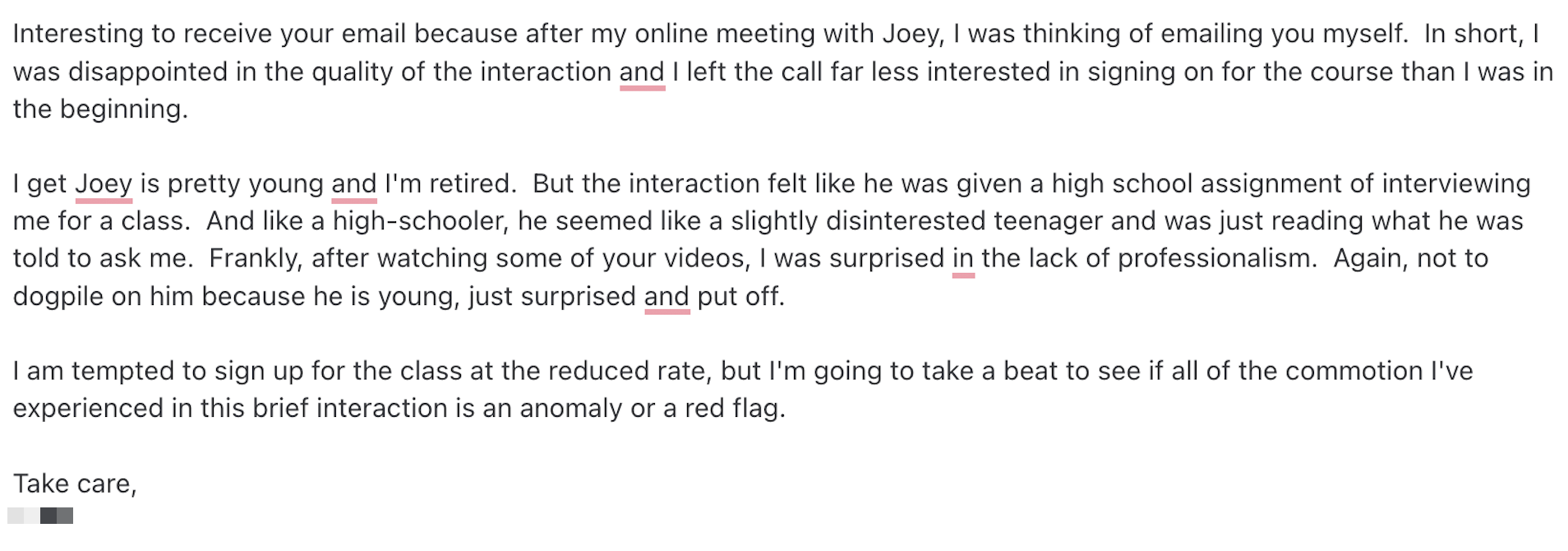
Actual email from a prospect describing their experience with MJB's closer.
This prospect was ready to buy my course. They'd watched my content, they were interested enough to apply and book a call, and MJB's closer turned them off so badly that they walked away. This person explicitly noted the disconnect between the quality of my content and the quality of MJB's sales representative. The closer made my brand look unprofessional.
This wasn't my opinion of the closer — this was a qualified, ready-to-pay lead's direct, unsolicited experience. And this is just one person who took the time to email. I don't know how many other prospects had the same experience and simply never came back.
The Pattern
Any one of these incidents in isolation could be forgiven as a mistake. Businesses are messy, things go wrong, and I understand that. But when you step back and look at the full timeline, a clear systemic pattern emerges at MJB Growth. These aren't isolated failures — they're symptoms of an organization that consistently over-promises and under-delivers.
- Promises made, not kept. Weekly Loom update videos that were never sent. Landing page drafts that missed deadlines with no communication. Demo calls proposed and never confirmed. Sales rep onboarding with zero visibility. Contracts that were never set up. At every stage of the engagement, commitments were made and quietly abandoned. There was never an acknowledgment that something had been missed — it would just not happen, and I'd have to be the one to chase it.
- Work delivered far below acceptable quality. The landing page rebuild ignored the copy I'd provided in a detailed Google Doc. Sections were crammed together. Design feedback was disregarded. The VA was using amateur workarounds (empty rows as spacers) instead of basic platform functionality. This was supposed to be the face of a premium, high-ticket offer, and it looked like it was put together by someone who had never used ClickFunnels before — because they hadn't.
- No proactive communication — ever. Throughout the entire engagement, I was the one chasing updates, asking for status, requesting calls. I was never proactively told about problems, delays, or changes. When the entire sales infrastructure collapsed on launch day and the closer was no-showing calls, I found out because my prospects emailed me — not because anyone on the MJB team flagged it. If I hadn't checked my own email, I might not have known for days.
- Technical incompetence from VAs and contractors. A VA deleted my landing page instead of creating a new one. Another VA didn't understand basic ClickFunnels controls. The calendar system offered prospects 2 AM time slots. The CRM was set up but never actually used by anyone on the team. These aren't judgment calls or strategic disagreements — they're basic competency failures from people who were presented as qualified professionals.
- No accountability from leadership. When I raised documented issues with specific evidence — screenshots, Loom recordings, Slack timestamps — Max Bates' response was defensive rather than accountable. Instead of saying "you're right, we dropped the ball, here's how we're fixing it," the response was passive-aggressive deflection. The closest thing to accountability was a soft "fine, do it yourself then" when I asked too many questions about why things weren't getting done. That's not leadership. That's avoidance.
- The sales team was not trained. The head of sales admitted he'd given reps the offer materials and told them to review on their own. No training sessions. No comprehension testing. No role-playing objection handling. No listening to practice calls. No quality assurance before they were put in front of real prospects with thousands of dollars on the line. The setters didn't know the offer. The closer didn't show up. And when I asked why, the answer was essentially "that's not how I manage." The result: three days of live launch, zero closes.
- The client was left doing the agency's job. I spent the majority of the engagement doing work that MJB was paid to do. I rebuilt the landing page they deleted. I rewrote the copy they botched. I supervised the VA's ClickFunnels work. I chased status updates. I emailed apologies to no-showed prospects. I took over sales calls. I managed the damage control. I was paying $15,000 for a done-for-you service, and I ended up doing more work than if I'd just done everything myself from the start.
What I'd Tell Anyone Considering MJB Growth
I'm not writing this out of anger. I've moved on and my business is doing fine. I'm writing this because when I was in your position — evaluating whether to hire MJB Growth — there was nothing out there. No reviews, no third-party accounts, no way to verify whether their promises matched their execution. I had to find out the hard way.
Before signing with any agency like MJB Growth:
- Ask for verifiable client references — not curated testimonials on their website, but actual clients you can speak with directly. I actually spoke to one of MJB Growth's previous clients from about a year prior, and she's one of the reasons I decided to give them a shot. She said it was a great experience for her business and urged me to try. But she was also one of the featured testimonials on their landing page, so of course her account was positive. Ask clients specifically about communication, follow-through, and what happened when things went wrong — and try to speak with clients who aren't already on the company's marketing materials.
- Verify the competence of whoever will touch your systems. Ask specifically who will be doing the work — not just who you'll talk to on the sales call. What's their experience with your specific tools? Have them demonstrate it. I was told I'd have qualified developers; I got VAs who didn't know how to use section padding and who deleted extremely valuable landing pages, creating enormous setbacks.
- Negotiate performance-based agreements where possible. A retainer with no performance accountability creates misaligned incentives. If I had structured the deal around results instead of a flat package fee, the outcome would have been very different — for both of us.
- Define communication SLAs upfront. Maximum response times, update cadences, escalation paths, and call availability should all be agreed upon in writing before money changes hands. "We'll keep you in the loop" means nothing without specifics.
- Maintain your own access and backups. I learned this the hard way when my landing page was deleted without a backup. Always have your own admin access, always export your own backups, and never let an agency be the only one with the keys to your business systems.
- Watch for the 10-day promise. MJB Growth's own marketing promises to have things ready in 10 days. My engagement lasted two months and still wasn't fully operational at launch. If the promise sounds too good, ask for a realistic timeline with milestones.
Frequently Asked Questions About MJB Growth
Final Thoughts
I'm not necessarily saying that MJB Growth doesn't have the skills to deliver results. If I had to guess, I'd say that when they were smaller, they had enough people to actually do things right. They've since gotten too big, and the quality of service, the attention to detail, and the leadership have fallen apart. Now they're resting on the laurels of results they got for some of their early clients while fumbling the ball with the clients they have now.
I blame Max Bates for this solely because it's his job as the leader and the founder of the company to make sure that there are robust systems in place and that customers are being taken care of — not dealing with them passive-aggressively when they ask for the bare minimum of what they paid for.
If this review seems damning, you should ask me what my opinion is — because everything you've read here is just the facts. I have done my best to keep this as objective and grounded in documentation as possible, but this has been an incredibly frustrating and infuriating experience. I've done my best to give MJB Growth a fair assessment and the benefit of the doubt. These are the facts. Use them as you will. Tread lightly. Enter at your own risk.